Every hobby teaches the same lesson: you get better by practising in small, regular sessions, not by panicking the night before. A potter learns to centre clay with twenty minutes at the wheel after work. A choir member learns a harmony line a few bars at a time. Preparing for the Life in the UK Test works much the same way, and the right practice tool makes those small sessions count.
This article walks through one such tool, the Life in the UK test practice page from Be Ready Education. It covers what the page offers, what it does not, and how to fit it around a life that already has art classes, craft nights or weekend sketching in it.
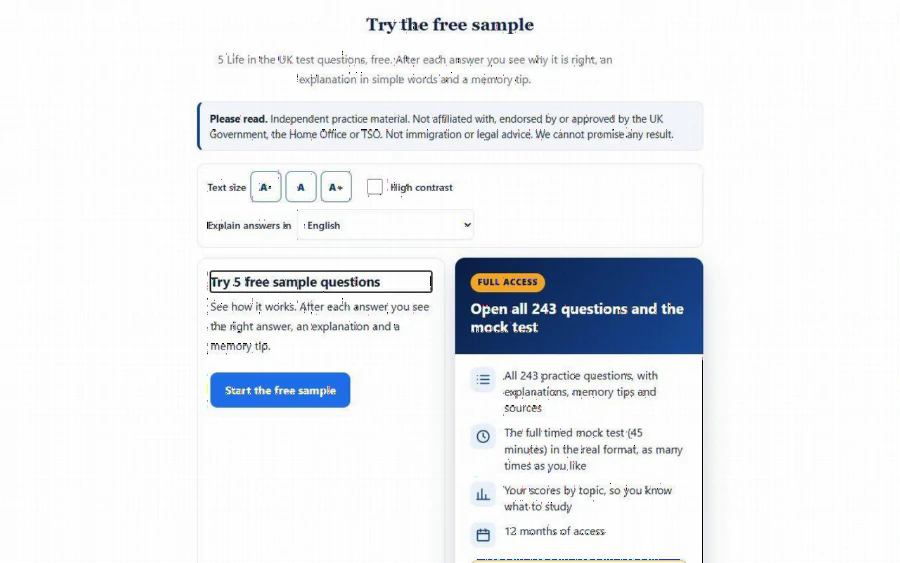
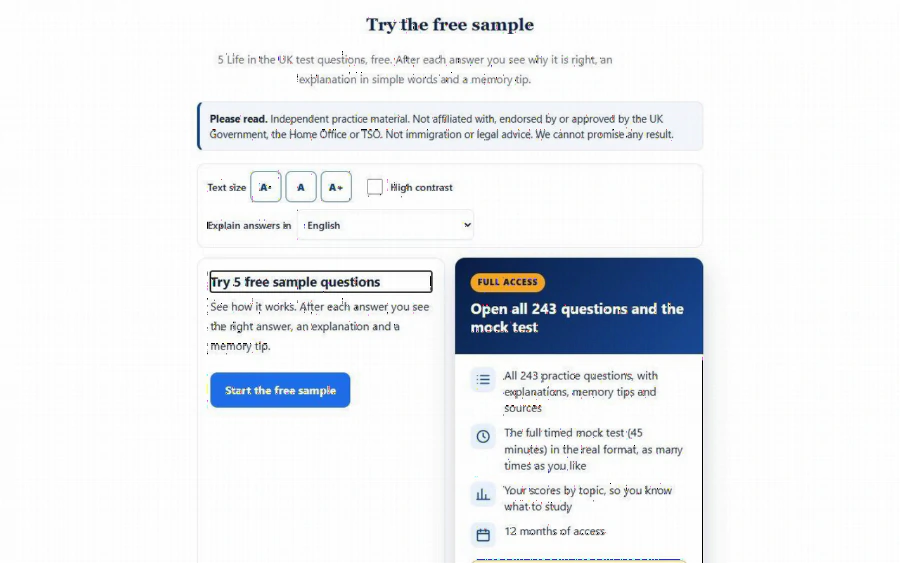
The free sample section of the Be Ready Education Life in the UK practice page, showing five free questions, a disclaimer and a full access summary
What the test asks of you
According to the Be Ready Education page, the Life in the UK Test has 24 multiple-choice questions, lasts 45 minutes and is taken at a test centre. The pass mark is 75 percent, which means 18 correct answers out of 24. The page says these details were checked against the UK government website in early November 2026, and it is always sensible to confirm the current rules on that website before you book anything.
Those numbers shape how you should practise. Twenty-four questions in 45 minutes is a comfortable pace, a little under two minutes each, so speed is rarely the problem. The harder part is the breadth: values and principles, how the UK is made up, history, modern society, and how government and law work. Most people who struggle do so because a few topics never stuck, not because they cannot read the questions.
What the page gives you
The page is built around a simple idea: try before you pay. Here is what it describes.
- Five free sample questions, with no sign-up. After each answer you see why it is right, an explanation in simple words and a memory tip.
- Full access to 243 practice questions, each with an explanation, a memory tip and a source.
- A timed 45 minute mock test, which you can repeat as many times as you like.
- Scores by topic, so you can see whether history or government is dragging you down.
- 12 months of access, starting straight after payment on Stripe's payment page. A link is also emailed to you as a backup, and the same link works on another device.
There is also a free key words video series covering 31 key words, with captions, plus a written list. Words such as Parliament or Cabinet are exactly the kind of vocabulary that decides whether a question makes sense at all.
At the time of writing, the page marks full access as opening soon and shows no price, so check the page itself for the current status and cost. Practice improves your understanding of the material. It does not guarantee a pass, and nobody can honestly promise one.
A practice routine that suits creative people
If your evenings belong to a sketchbook, a guitar or a half-finished quilt, you probably do not want to hand them all over to study. A short routine is more realistic.
1. Start with the free sample. Do the five questions in one sitting and read every explanation, including for the ones you got right. This takes about ten minutes and shows you how the explanations are written.
2. Study by topic, not by order. If the topic scores show you are weak on history, spend three evenings of fifteen minutes there before touching anything else.
3. Pair study with a habit you already have. Read the key words list with your first coffee. Do a few questions while the paint dries or the kiln cools.
4. Save the timed mock test for the end. Take it once your topic scores look steady, and treat it seriously: no phone, no notes, 45 minutes.
5. Go back to the memory tips. A short image or rhyme is easier to carry into the test room than a paragraph.
A person who makes things tends to like seeing progress in pieces. Scores by topic give you exactly that: a small, honest picture of which part of the canvas is still blank.
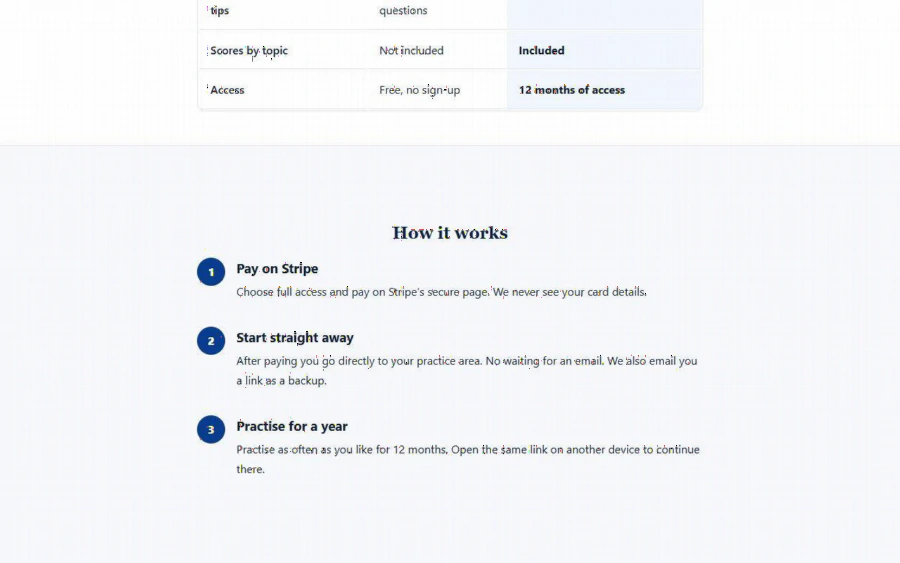
The How it works section of the practice page, showing three steps: pay on Stripe, start straight away, practise for a year
A scenario: the weekend printmaker
Picture someone who has lived in the UK for several years and spends Saturday mornings at a community print studio. Their English is fluent at work, but they have never read much about British history or how Parliament passes a law. They sit down with the free sample on a Sunday evening, get three of five right, and notice that the explanations in simple English are what really help, because they say why the wrong choices are wrong.
Over the next three weeks they spend fifteen minutes a day on history and government, read the key words list on the bus, and check their topic scores each weekend. By the time they try the 45 minute mock test, nothing in it feels like a surprise. That is not a promise of what will happen to you. It is simply what steady, small-session practice looks like when the tool is built for it.
A second option: the Udemy exam simulator
Be Ready Education also publishes a separate exam simulator course on Udemy. It is an exam simulator, not a video course. According to its course description it offers five timed practice tests of 24 questions each, 120 different questions in total, with a 45 minute limit per test. Each answer choice, right or wrong, has a short reason in simple English, followed by the same explanation in Vietnamese, Polish and Romanian.
That makes it a useful alternative if you would rather study in one of those languages while still learning the English words you will see in the test. The course description notes that the translations have not been reviewed by native-speaker examiners, so treat them as study aids, and that the questions and answer choices stay in English, as they do in the test itself.
Limits worth knowing about
- It is independent material. The page states clearly that it is not affiliated with, endorsed by or approved by the UK Government, the Home Office or TSO. The questions are written by Be Ready Education, based on the topics of the published study material.
- It is not advice. This is practice material, not immigration, migration or legal advice. If you have questions about your own case, speak to a regulated immigration adviser or a solicitor and check the government website.
- Question wording will differ. Practice questions are written to teach the same facts, but the wording and style on test day may not match them. Use practice to build knowledge, not to memorise phrasing.
- The page is English-focused. The practice page names English only (standard and simple). If you want explanations in another language, look at the Udemy course described above.
- No result can be promised. Be wary of anyone who says you will definitely pass.
Who it suits, and who it does not
It suits people who want to understand why an answer is right, who like short and regular sessions, and who want to see progress by topic. It suits learners who prefer to try a free sample before committing, and anyone who would like accessibility options such as larger text and a high-contrast mode, which the page lists.
It is a poorer fit if you want a printed handbook, a live tutor, or help with an application itself. It will not replace reading the study material, and it cannot answer legal questions about your situation.
How to begin today
Open the practice page, try the five free questions and read the explanations carefully. If the style works for you, decide whether full access or the Udemy simulator suits your language and budget. The wider other country test guides from Be Ready Education lists the other tests Be Ready Education covers.
Then do what any good maker does: show up for a short session tomorrow, and the day after. Small, steady practice beats a last-minute rush every time. This guide is independent study material and is not immigration advice.