Hobbyists tend to learn the same way. A woodworker watches a ten-minute clip before touching a chisel. A home cook pauses a video to copy one knife technique. A sketch artist studies one shading trick at a time. Small, visual lessons stick because they ask for a few minutes, not a free weekend. That same habit is useful for a very different kind of learning: preparing for the Canadian citizenship test, where unfamiliar words like "riding" or "royal assent" can make a study guide feel heavier than it is.
This article looks at one resource built around that idea, the short key words video lessons for the Canadian citizenship test from Be Ready Education. I read the page itself and quote only what it states.
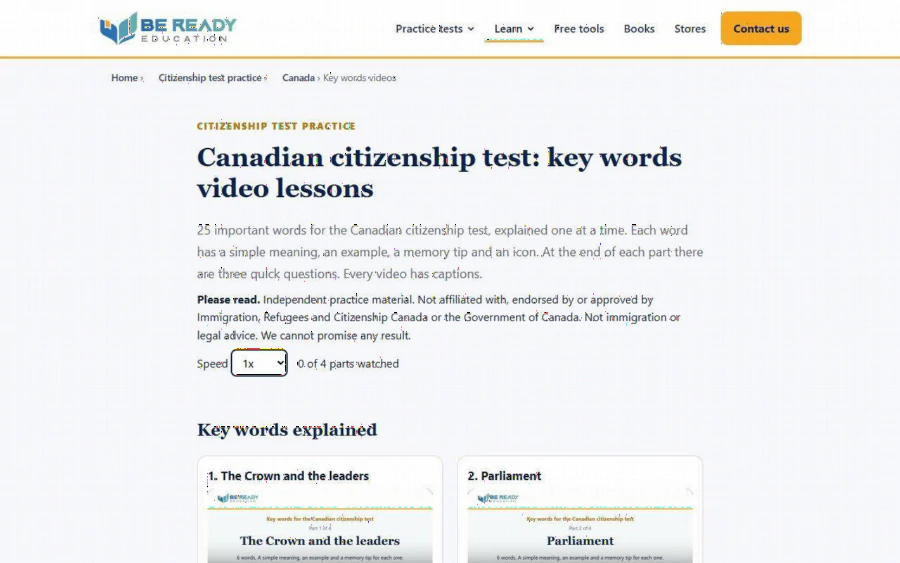
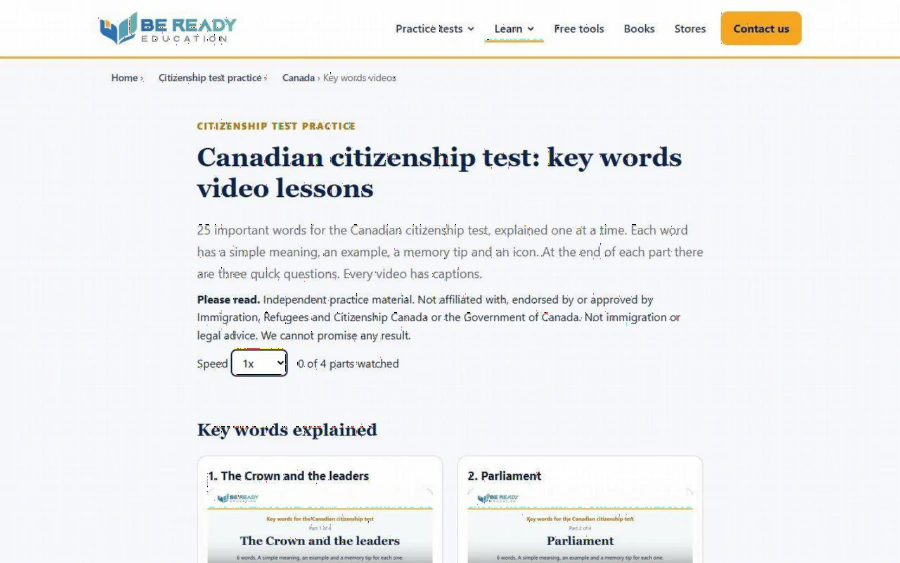
The Be Ready Education page for the Canadian citizenship test key words video lessons, with its notice that the material is independent practice material
What the page actually offers
According to the page, the course covers 25 key words, and each word is taught in its own short video. Every word comes with a simple meaning, an example, a memory tip and an icon. The words are grouped into four parts:
- The Crown and the leaders (6 words): Sovereign, Governor General, Prime Minister, Premier, Mayor, Cabinet
- Parliament (6 words): Parliament, House of Commons, Senate, Member of Parliament, Opposition, Royal Assent
- Elections, rights and courts (6 words): Riding, Ballot, Minority government, Charter, Supreme Court, Presumption of innocence
- The country and its peoples (7 words): Confederation, Federal, Constitution, Province, Territory, Aboriginal peoples, Francophone
Each part ends with three quick questions. Every video has captions, and captions can be downloaded for each of the four parts as .vtt files. The player offers speed options from 0.75x to 1.5x, and the page keeps a count of how many of the four parts you have watched. When I opened it, the counter read "0 of 4 parts watched."
One detail I liked: the page says the words are ordered by how easy they are to learn, not by the order of any official book. For a casual learner that is a sensible choice, because you can build confidence on familiar ideas such as a mayor or a ballot before moving to a term like minority government.
Why short videos suit a hobbyist mindset
Think about how people pick up a craft. Nobody memorizes a manual. They watch, try, rewatch the confusing bit and move on. Vocabulary for a civics test works well in that rhythm, because the words are concrete and repeat across the study material. If you learn what a Premier does compared with a Prime Minister, a good share of the guide becomes easier to read.
Here is a small illustration, clearly invented for this article. Imagine someone who spends Saturday mornings at a pottery class. She has a test coming and only twenty free minutes on weekday evenings. Instead of reading a long chapter, she watches one part, replays the word "Charter" at 0.75x with captions on, answers the three quick questions, and stops. Over four evenings she has been through all four parts. That is the kind of pacing the format allows, though nothing on the page promises it will work for any particular person.
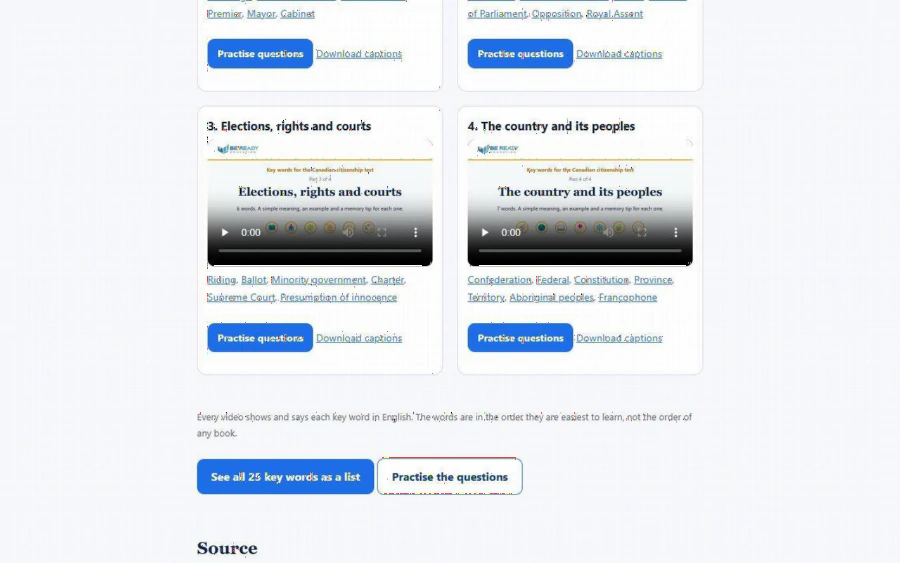
Lower part of the key words page showing parts three and four, each with a video player, the list of words, a practice questions button and a captions download link
Strengths worth naming
Based on what the page shows, a few things stand out.
First, the scope is small and clear. Twenty-five words is a number a person can hold in their head. You know when you are done.
Second, accessibility has been thought through. Captions on every video, downloadable caption files and adjustable speed matter for people who are learning in a second language, which is likely for much of the audience.
Third, the page is open about its limits. A notice headed "Please read" says the material is independent practice material, that it is not affiliated with, endorsed by or approved by Immigration, Refugees and Citizenship Canada or the Government of Canada, that it is not immigration or legal advice, and that no result can be promised. The page also says the questions and meanings are the site's own wording and follow the topics of the published study guide, without copying the guide's text or using government logos or images.
Fourth, the lessons connect to practice. Each part links to practice questions, and there is a link to see all 25 key words as a list if you prefer reading to watching.
Limits you should know before you start
Honesty matters more than enthusiasm here, so here are the gaps I found.
The page does not state the length of the videos, individual or total, so I cannot tell you how many minutes the course takes. It also does not show the actual memory tips or example sentences in text form, so you will need to watch to judge their quality. Every video shows and says each key word in English, which helps if you want to learn the English term but may be less helpful if you need explanations in another language.
Most important, vocabulary is only part of the picture. Knowing 25 words will not by itself prepare anyone for a full test. According to the citizenship practice section, the Canadian format is 20 questions with 15 correct needed to pass, and the page gives no other Canada-specific details. Think of the videos as a warm-up for the study guide, not a replacement for it. Nobody should read this article or the videos as a guarantee of a result, and eligibility or application questions belong with a registered migration agent or lawyer, as the site itself says.
Who should use it, and who should not
The videos fit people who find long guides intimidating, who learn better by listening and watching, and who want to understand terms before attempting practice questions. They also suit family members helping someone prepare, since a short clip is easy to watch together.
They fit less well if you already know Canadian civics well and only want timed mock tests, or if you need explanations in a language other than English. In that case, go straight to practice questions.
How to get started
A simple plan is enough:
1. Open the page and read the notice at the top, so you know what the material is and is not.
2. Watch part one with captions on, and replay any word that feels fuzzy.
3. Answer the three quick questions at the end of the part.
4. Repeat for parts two, three and four, then look at the full list of 25 words once.
5. Move on to the practice questions and your official study guide.
If you want wider practice, Be Ready Education has a broader citizenship test practice section covering Australia, the United States, the United Kingdom and Canada. It lists free sample questions for each country with no sign-up, timed mock tests, a source for every answer, and a full pack at US$59.99 for 12 months of access with no subscription, as shown on that page at the time of writing. Prices and terms can change, so check the page before you decide.
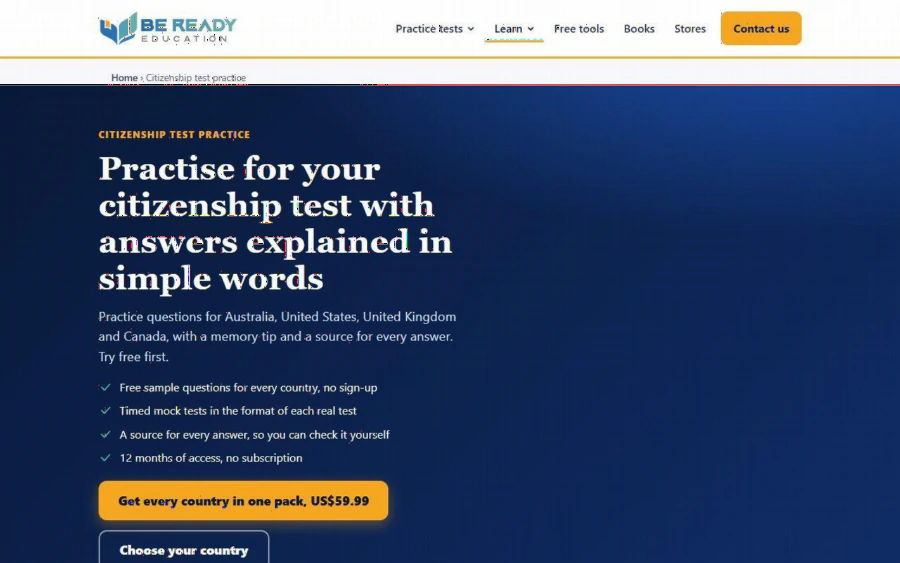
The Be Ready Education citizenship test practice page listing free sample questions, timed mock tests and a source for every answer
Final thoughts
Learning a new set of terms is a lot like picking up a new hobby: start small, repeat often and enjoy the small wins. These short lessons will not do the whole job, and they do not pretend to. What they offer is a gentle first step into the vocabulary of Canadian government, in plain words, with captions and a few questions to check yourself. For many learners, that is exactly the right place to begin.